
Introduction
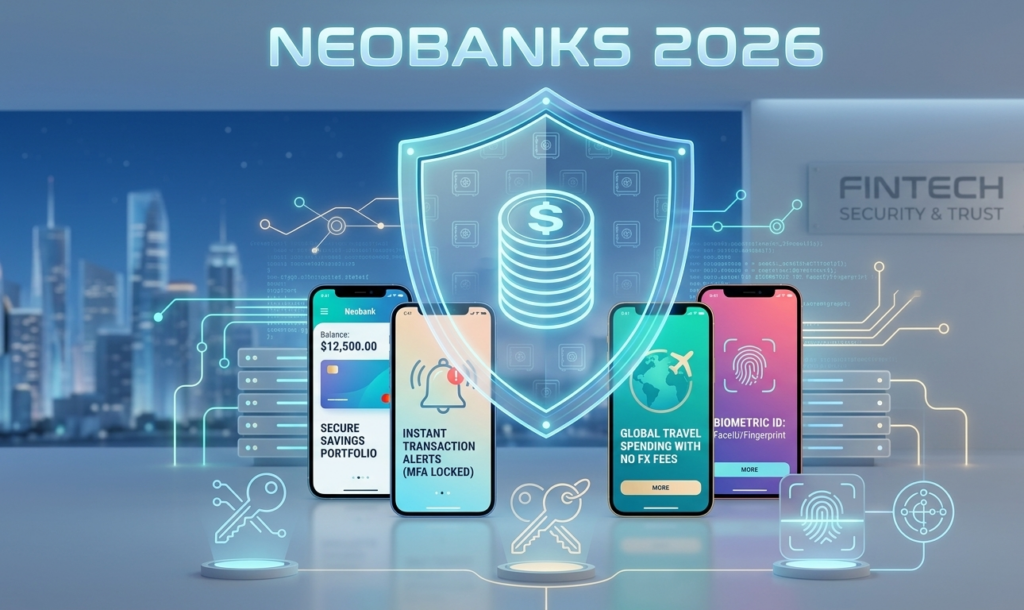
The rapid transition from traditional brick-and-mortar institutions to Digital-Only Banks has sparked a crucial debate: Is your money actually safe in a bank that doesn’t have a physical vault? As we move through 2026, Neobank Security has become the gold standard for the financial industry, often surpassing the protection offered by legacy banks.
In this comprehensive guide, we will break down the multi-layered security protocols, the legal safeguards, and the cutting-edge Fintech Innovations that keep your hard-earned savings secure in the digital age.
1. The Legal Shield: Understanding Banking Licenses
The biggest fear users have is the «disappearing act»—the idea that a digital app could vanish overnight. However, reputable neobanks operate under strict Financial Regulations.
- Full Banking Licenses: Institutions like N26 or Starling Bank hold full licenses, meaning they are subject to the same audits as giants like HSBC or JP Morgan.
- Deposit Insurance: This is the most critical factor. In the US, your funds are protected by the FDIC up to $250,000. In the UK, the FSCS covers up to £85,000.
- Electronic Money Institutions (EMI): Some neobanks operate as EMIs. They don’t «lend» your money to others; they «safeguard» it in segregated accounts at central banks, meaning even if the neobank goes bankrupt, your money remains untouched.
2. Advanced Biometric Authentication
Traditional banks often rely on passwords and security questions (like your mother’s maiden name), which are easily compromised by Phishing Attacks. Neobanks have shifted the battlefield to Biometrics.
- FaceID and Fingerprint Scanning: Access to your funds is tied to your physical biology, making remote hacking nearly impossible.
- Multi-Factor Authentication (MFA): Every transaction requires a «handshake» between your app, your device, and often a biometric scan or a hardware-bound token.
- Behavioral Analytics: Modern neobanks use Artificial Intelligence to build a profile of how you spend. If you suddenly try to buy a $5,000 watch in a country you’ve never visited, the AI freezes the transaction in milliseconds.
3. Real-Time Card Control: Power in Your Pocket
One of the most revolutionary features of Digital Banking is the ability to control your hardware via software.
- Instant Freeze: If you lose your card at a restaurant, you don’t call a 1-800 number. You toggle a button in the app to «Freeze» it instantly.
- Virtual Disposable Cards: For online shopping, neobanks like Revolut offer cards that «destroy» themselves after a single use. This prevents hackers from stealing your card details from a compromised website.
- Geolocated Security: The app can compare the location of your phone with the location of the ATM. If they don’t match, the withdrawal is declined.
4. Comparison: Security Features 2026
| Security Feature | Neobanks (e.g., Monzo) | Traditional Banks (e.g., Barclays) |
| Instant Notifications | Standard (Real-time) | Often Delayed (Hours/Days) |
| Card Freezing | In-App (Instant) | Often requires a phone call |
| Virtual Cards | Unlimited/Disposable | Rarely Offered |
| AI Fraud Detection | Real-time / High Precision | Batch Processing / Slower |
5. Protecting Your Privacy in a Digital World
Beyond just money, Data Privacy is a core pillar of Sustainable Fintech. Neobanks in 2026 are heavily regulated by GDPR (in Europe) and various state privacy laws in the US.
Unlike traditional banks that may sell «anonymized» data to marketers, many neobanks use their privacy-first approach as a marketing advantage. They employ End-to-End Encryption for all communications between your smartphone and their servers, ensuring that your financial history stays between you and your bank.
6. How to Verify a Neobank’s Safety
Before you deposit your life savings, follow this Security Checklist:
- Check the License: Look at the bottom of their website for phrases like «Authorized by the Prudential Regulation Authority» or «Member FDIC.»
- Review the 2FA Options: Ensure they offer more than just SMS codes (which can be intercepted via SIM Swapping).
- Audit their Transparency: Do they have a clear, easy-to-read privacy policy?
7. Recommended Secure Neobanks
If you are looking for the most secure platforms to start your digital journey, consider these industry leaders:
- Revolut Security Center: Learn about their vault protection and anti-fraud systems.
- Chime Safety Features: See how they protect US consumers with FDIC insurance.
- N26 Protection Insurance: A deep dive into European banking security standards.
- Monzo Fraud Protection: How they use community data to stop scammers.
8. The Future: Quantum-Resistant Banking
As we look toward the late 2020s, neobanks are already testing Post-Quantum Cryptography. This ensures that even when quantum computers become powerful enough to break current encryption, your bank account remains a fortress. The integration of Blockchain Technology for internal ledgers is also making the records of your transactions immutable and impossible to forge.
Conclusion: A New Era of Trust
The verdict for 2026 is clear: Neobanks are safe. In many ways, they are safer than traditional banks because they were «born in the cloud.» They don’t have to deal with 40-year-old «legacy systems» that are full of security holes. By combining Banking Licenses with Elite Technology, neobanks provide a secure, transparent, and efficient way to manage your wealth.
Secure your financial future by choosing a partner that treats security not as a department, but as the very foundation of their code.