
Introduction
For decades, the banking industry operated behind a veil of secrecy. Most customers had no idea that their savings were being used to fund fossil fuel expansion, tobacco manufacturing, or arms trading. However, the rise of Sustainable Neobanking in 2026 has brought a new level of transparency to personal finance. Today, choosing a bank is no longer just a financial decision; it is a moral one.
Ethical Fintech platforms are proving that you don’t have to sacrifice high interest rates to support environmental and social causes. By leveraging technology, these neobanks are allowing users to align their wealth with their personal values.
1. The Transparency Gap: Old Banks vs. New Ethics
Traditional banks often operate on «General Funds,» where all deposits are pooled together to maximize profit, regardless of the industry being funded. Neobanks, however, have introduced the concept of Direct Impact Banking.
Key Differences in Investment Philosophy:
- Exclusionary Screening: Ethical neobanks automatically block investments in «Sin Stocks» (gambling, weapons, fossil fuels).
- Positive Impact Tracking: Your money is directed toward renewable energy projects, social housing, and sustainable agriculture.
- Real-Time Auditing: Users can see exactly which projects their deposits are supporting through a live dashboard in the app.
2. Comparing the «Green» Performance (2026 Data)
Many people worry that «Green Banks» offer lower returns. The data from 2026 shows that Sustainable Portfolios are actually outperforming traditional ones due to the global transition toward clean energy.
| Metric | Traditional Big Banks | Sustainable Neobanks |
| Carbon Footprint per $1k | High (~1.5 tonnes $CO_2$) | Near Zero / Offset |
| Savings APY | 0.05% | 4.75% – 5.10% |
| Investment Focus | Diversified / Non-disclosed | ESG (Eco-Social Governance) |
| Card Material | Virgin Plastic | Ocean Plastic / Wood / Metal |
3. Top Features of Eco-Friendly Neobanks
Digital-first banks are using Artificial Intelligence to help users live more sustainably without changing their daily routines. These are the top features integrated into ethical platforms today:
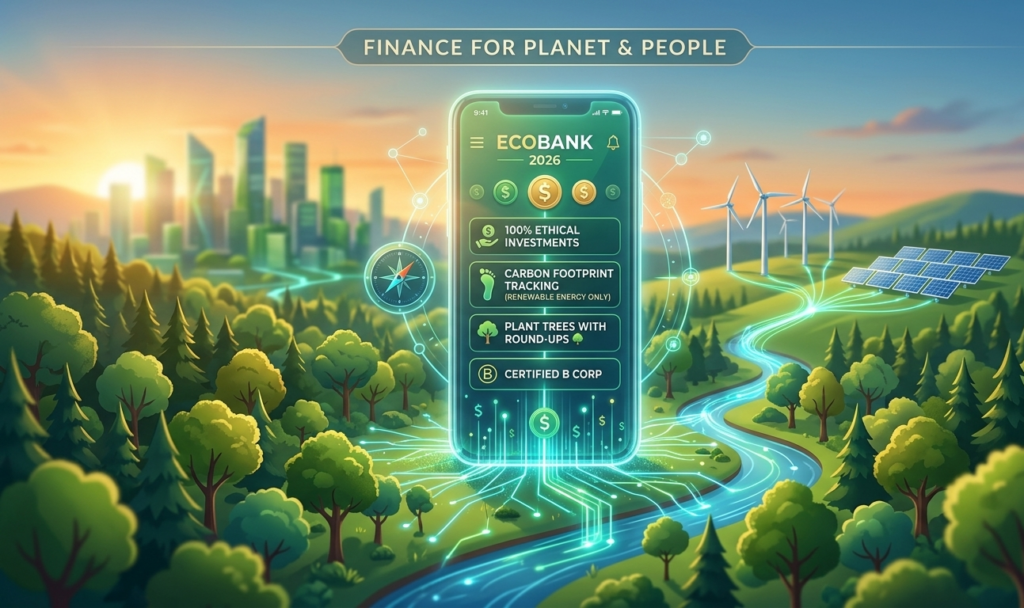
- Carbon Footprint Tracking: Every time you buy groceries or fuel, the app calculates the estimated $CO_2$ emissions of that purchase.
- Automatic Offsetting: You can set your account to «Round-up» purchases to the nearest dollar, with the change going directly to reforestation projects.
- Eco-Incentives: Some banks offer «Cashback» rewards for shopping at certified sustainable businesses or using public transport.
- Vocal Advocacy: Unlike traditional banks that lobby for legacy industries, ethical neobanks use their platform to push for Climate-Positive Legislation.
4. Leading Ethical Neobanks to Watch
If you want your money to make a difference, these are the platforms leading the charge in 2026:
Tomorrow: The Sustainability Champion (EU)
Based in Germany, Tomorrow has become the gold standard for European ethical banking. They ensure that not a single cent of customer money goes into the «old» economy.
- Best for: Carbon-neutral living.
- Visit Tomorrow Official Site
Aspiration: Banking for the Climate (US)
Aspiration has revolutionized the US market by offering «Planet Protection,» which offsets the carbon from every gallon of gas you buy.
- Best for: Reforestation and personal impact tracking.
- Visit Aspiration Official Site
Bunq: The «Bank of the Free» (Global)
Bunq allows users to plant a tree for every €100 spent. In 2026, they have planted millions of trees, creating entire forests funded solely by digital transactions.
- Best for: Digital nomads who want to offset travel emissions.
- Explore Bunq Features
5. Security and Trust in Ethical Finance
A common question is: Is my money as safe in a «Green Bank» as it is in a traditional one? The answer is a resounding yes. Ethical Neobanks are held to the same Financial Regulations as any other bank.
- Fully Regulated: They hold the same banking licenses (FDIC, FSCS, or ECB regulated).
- Encrypted Privacy: Your data is protected by AES-256 Encryption, ensuring your «Green Spending» stays private.
- Segregated Accounts: Your money is stored in protected accounts that the bank cannot use for its own operational costs.
6. How to Transition to a Sustainable Account
Making the move to an ethical neobank is a powerful way to vote with your wallet. Most users follow these four steps to ensure a smooth transition:
- Check the «Green Score»: Use independent sites to see how your current bank ranks in terms of fossil fuel investment.
- Open a «Primary» Ethical Account: Move your daily spending card to a green provider first.
- Audit Your Investments: If you have a 401k or a stock portfolio, use the neobank’s tools to migrate them to ESG-Compliant Funds.
- Influence Others: Use the app’s social features to show your friends how many trees you’ve planted just by paying your bills.
7. Useful Resources and External Links
To verify the impact of your banking choices, we recommend these independent organizations:
- Bank.Green: A tool to see if your bank is funding the climate crisis.
- B Corp Directory: Find banks that are certified for social and environmental performance.
- Global Alliance for Banking on Values: An international network of banks with a mission to use finance for good.
8. Conclusion: The Power of Conscious Capital
The era of «blind banking» is over. In 2026, we understand that money is a form of energy—and where we direct that energy determines the future of our planet. Ethical Neobanking is not just a niche market; it is the inevitable evolution of Personal Finance.
By choosing a bank that prioritizes Sustainability, transparency, and social justice, you are ensuring that your financial success doesn’t come at the expense of the earth. The tools are ready, the technology is secure, and the impact is real. It is time to make your money work for you and the world.